
 720-765-7214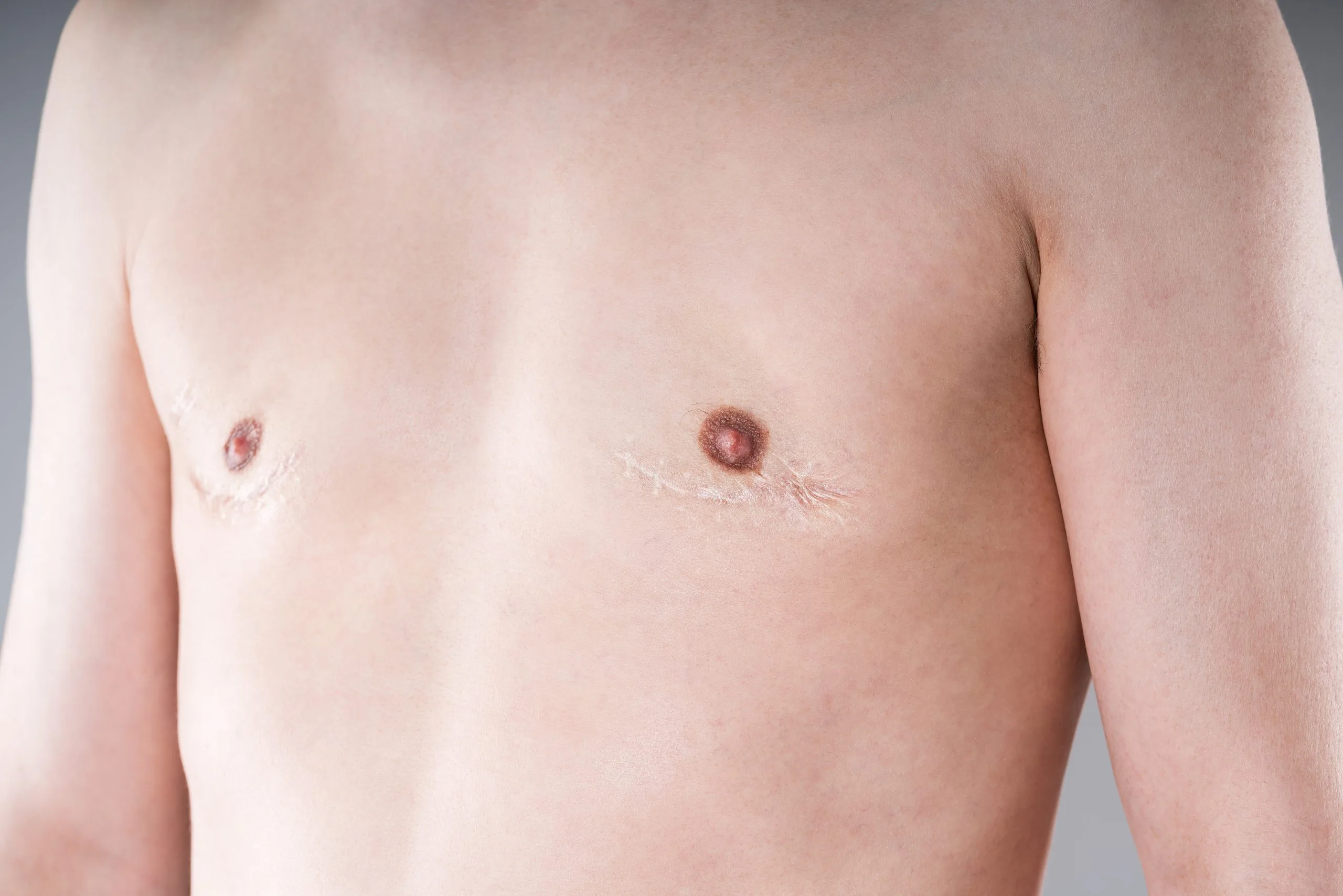
How to Minimize Top Surgery Scars: A Complete Guide
The most effective way to minimize top surgery scars is to combine careful surgical planning, strict wound protection during the first six weeks, and consistent long-term scar care using silicone, sun protection, and massage for a full year after surgery. Scars from top surgery are permanent, but with the right approach they can fade into thin, flat, pale lines that blend into the chest and are barely noticeable at conversational distance.
At Flourish Surgical Arts in Denver, Dr. John Nesiba has performed more than 1,000 surgeries over seven years of practice, including FTM top surgery and MTF top surgery. Scar placement and healing are part of the planning conversation from the very first consultation, not an afterthought.
Understanding Top Surgery Scars
Any time skin is cut through the dermis – the deeper layer holding collagen, blood vessels, and hair follicles – the body cannot regrow the original tissue. Fibroblast cells arrive and patch the gap with collagen, and that collagen patch is a scar.
Top surgery requires incisions, so scars are inevitable. The goal is a good scar: thin, flat, level with the surrounding skin, and close in color to the rest of your chest.
Healing happens in overlapping phases:
Inflammatory phase (first few days): The body controls bleeding and sends inflammatory cells to clean the wound. Incisions look red, swollen, and slightly raised.
Proliferative phase (first few weeks): New collagen is laid down quickly and messily, which is why a fresh scar often looks red, raised, darker, and firm.
Maturation phase (6 months to 2 years): The body remodels collagen, breaks down excess, and reorganizes fibers into a flatter, more orderly line as blood flow decreases.
Most of what you do to minimize scarring is aimed at supporting that remodeling phase.
Pre-Surgery Steps to Minimize Scarring
Understanding how to minimize top surgery scars starts weeks before your procedure date, not after.
Choose your surgeon based on chest work specifically. Incision placement, tension management, and closure technique are learned skills. Dr. John Nesiba’s background includes fellowship training and expertise in facial reconstruction and orthognathic surgery, with more than 1,000 cosmetic surgeries performed.
Talk about scar placement explicitly at consultation. Ask where incisions will sit relative to your pectoral border and what happens if your skin doesn’t retract as much as hoped. Consultations run 45 minutes. Virtual Zoom consultations are available if you’re traveling from outside Denver.
Complete your medical clearance early. Blood work and an EKG from your primary care physician are required, along with a signed medical clearance letter. Medical history forms are emailed after scheduling and must be completed before your appointment so Dr. John Nesiba can review them with you in person.
Optimize skin condition. Treat any active acne, folliculitis, or eczema on the chest before surgery. Inflamed skin heals into inflamed scars.
Lifestyle and Medical Considerations
Stop all nicotine. Cigarettes, vapes, patches, gum, pouches – all of it. Aim for at least four to six weeks before surgery and six weeks after. Nicotine is a vasoconstrictor and the single most damaging modifiable factor for wound healing and scar quality.
Get your protein up. Collagen is protein. Aim for consistent protein intake in the weeks before and after surgery.
Address vitamin deficiencies. Vitamin C is required for collagen cross-linking, Vitamin A supports tissue repair, zinc supports healing, and iron deficiency limits oxygen delivery. Correct known deficiencies beforehand.
Stay hydrated. Hydration supports healthy skin and optimal blood flow, delivering oxygen and nutrients to healing incisions.
Stabilize your weight. Significant weight change after surgery stretches or loosens chest skin, which can widen scars.
Review medications and supplements. Aspirin, NSAIDs, blood thinners, and certain herbal supplements increase bleeding and bruising, which prolongs inflammation. Review your full list at your pre-op visit.
Plan for real rest. Recovery is typically 10 to 14 days, with limited arm movement for the first two weeks. Arrange time off, help at home, and clothing that opens in front.
Protect your chest from the sun beforehand. A sunburned or heavily tanned chest is more prone to pigment changes during healing.
Essential Scar Care Right After Surgery
The first six weeks set the trajectory. Everything after that is refinement.
Follow activity restrictions exactly. Reaching, lifting, and pulling a shirt over your head all pull directly across the incision line. A scar stretched during week two will be visibly wider at month twelve.
Wear compression as directed. Post-surgical binders and compression garments reduce swelling, limit fluid collection, minimize tension, and hold tissue steady against the chest wall.
Keep incisions clean and dry per instructions. Follow the specific wound care protocol you’re given. Don’t improvise with hydrogen peroxide, rubbing alcohol, or antiseptic soaps – these damage the new cells doing the repair work.
Don’t pick at scabs or steri-strips. Let dressings and tapes fall off on their own or be removed at your follow-up visits.
Show up to every follow-up. The day-after, one-week, two-week, one-month, and three-month visits exist so problems are caught while they’re still fixable.
Manage swelling. Sleeping slightly elevated in the early weeks reduces fluid pooling in the chest.
Scar Management Techniques That Work
Once incisions are fully closed and your surgeon clears you – usually around two to four weeks, when surgical tape and scabs are gone – active scar management begins.
Silicone. Silicone sheets and gel are the most evidence-supported non-invasive scar treatments and the gold standard for scar management. They hydrate the scar and regulate collagen production. Sheets stay on 12 to 24 hours a day; gel is applied twice daily and is easier for large or curved areas. Two months of daily use beats six months of occasional use.
Paper tape or surgical tape. Taping across the scar offloads mechanical tension – a simple, low-cost way to reduce widening during the vulnerable weeks.
Sun protection. Apply broad-spectrum SPF 30 or higher daily to any exposed scar for at least the first year. Denver sits at 5,280 feet, and UV exposure increases roughly 4% per 1,000 feet of elevation – sun protection here is not optional. Better yet, keep scars covered with clothing.
Scar massage – when cleared. Gentle massage breaks down dense collagen bundles and improves pliability. After explicit clearance from Dr. John Nesiba, use firm, circular pressure with an unscented, non-irritating moisturizer or oil for five to ten minutes, twice daily.
Long-Term Scar Care Strategies
Scar maturation runs 12 to 18 months. Most people stop treatment far too early – usually right when the scar hits peak redness at month three, and they assume nothing is working.
Build a routine you can actually sustain:
Morning: Sunscreen on any exposed scar, every day, year-round.
Evening: Silicone gel or sheet, plus a few minutes of massage.
Weekly: Take a photo in the same lighting and position. Month-to-month change is hard to see in the mirror but obvious in photos.
Also worth knowing:
Keep moisturizing. Scar tissue lacks oil glands and stays dry, which makes it stiffer and itchier. A simple unscented moisturizer helps.
Protect scars from friction. Backpack straps, weight-lifting bars, seatbelts, and rough fabric cause micro-trauma that keeps a scar inflamed.
Return to exercise gradually. Chest and shoulder movements pull directly across top surgery scars. Follow your surgeon’s timeline for upper-body work.
Proven Methods for Fading and Minimizing Scars
Ranked roughly by strength of evidence:
Medical-grade silicone, used daily for at least three to six months.
Tension offloading through tape, activity modification, and compression.
Consistent sun protection for a minimum of 12 months.
Scar massage, once cleared, done regularly rather than occasionally.
Nutrition and nicotine avoidance throughout the healing period.
Scar Treatment Options
Topical Treatments for Scar Improvement
Vitamin E
Vitamin E is the most commonly recommended scar remedy and one of the least supported by evidence. Multiple studies found no meaningful improvement, and a notable percentage of users develop contact dermatitis – which makes scars worse by adding inflammation. If your moisturizer contains vitamin E, that’s fine; just don’t rely on it as your primary strategy, and discuss it with your provider first.
Onion Extract
Onion extract (Allium cepa) is the active ingredient in several over-the-counter scar gels, including products like Mederma. It has anti-inflammatory properties, and some research supports modest improvement in scar texture and redness, though results vary and are generally less impressive than silicone. Many products combine onion extract with silicone – a reasonable choice, but the silicone is likely doing most of the work.
Prescription Creams
Hydroquinone and pigment-regulating agents address hyperpigmentation around a scar.
Topical retinoids increase cell turnover and can improve texture.
Prescription corticosteroid creams calm an itchy, inflamed hypertrophic scar.
All of these require professional guidance – they can irritate immature scar tissue and make things worse at the wrong stage.
Non-Surgical Procedures
Our Denver practice offers advanced treatments to improve scar texture and color.
Laser Therapy
Vascular lasers target the blood vessels feeding a red scar, reducing redness and often softening thickness. These can sometimes be started relatively early in healing.
Fractional lasers create controlled columns of injury that stimulate collagen remodeling, improving texture, height, and pliability. Laser resurfacing is typically done as a series of treatments spaced weeks apart.
IPL. IPL addresses pigment and redness in and around a scar, but not raised texture.
Laser choice depends on skin tone, scar type, and scar maturity. Deeper skin tones require careful device and setting selection to avoid pigment changes.
Steroid Injections
Corticosteroid injections – usually triamcinolone – delivered directly into a thick scar suppress the overactive fibroblasts producing excess collagen. This is a first-line treatment for hypertrophic scars and keloids, typically spaced four to six weeks apart across several sessions. Most patients see meaningful flattening and softening, plus quick relief from itching and tenderness.
Microneedling, RF Microneedling, and Morpheus8
Microneedling uses fine needles to create controlled micro-injuries that stimulate organized collagen and elastin production. Particularly useful for texture irregularities and scars sitting slightly below skin level.
RF (radiofrequency) microneedling, offered at Flourish Surgical Arts, adds radiofrequency energy delivered into the deeper dermis for stronger collagen remodeling and skin tightening. Because energy is delivered below the surface rather than damaging the top layer, it’s generally considered safer across a wider range of skin tones. Makeup can be worn 48 hours after treatment.
A series of treatments spaced several weeks apart produces the most improvement, usually started once the scar has matured somewhat – several months after surgery at minimum.
Conclusion
Minimizing top surgery scars comes down to consistent care before and after surgery: prepare your body, protect your incisions, use silicone and sun protection, and seek early treatment for any abnormal scar changes. With patience and the right approach, most scars will fade and flatten over time.

About the Author
Dr. John R. Nesiba
August 8, 2026